
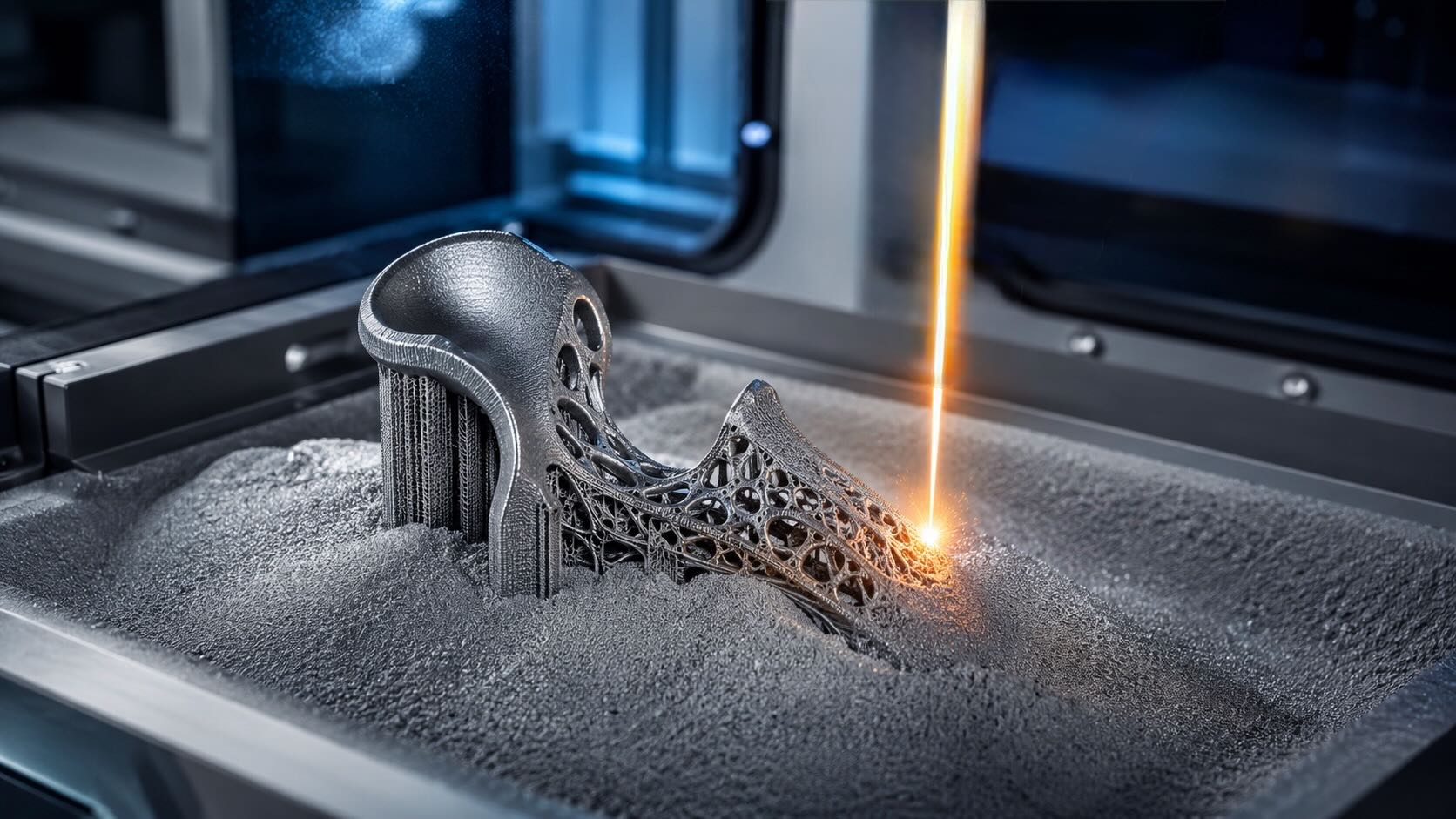
Additive manufacturing is changing the way complex metallic components can be designed and produced. Instead of removing material from a solid block, additive manufacturing builds parts layer by layer directly from digital 3D data. This approach is particularly attractive for medical applications, where implants often need to combine complex geometries, high mechanical performance and patient-specific design.
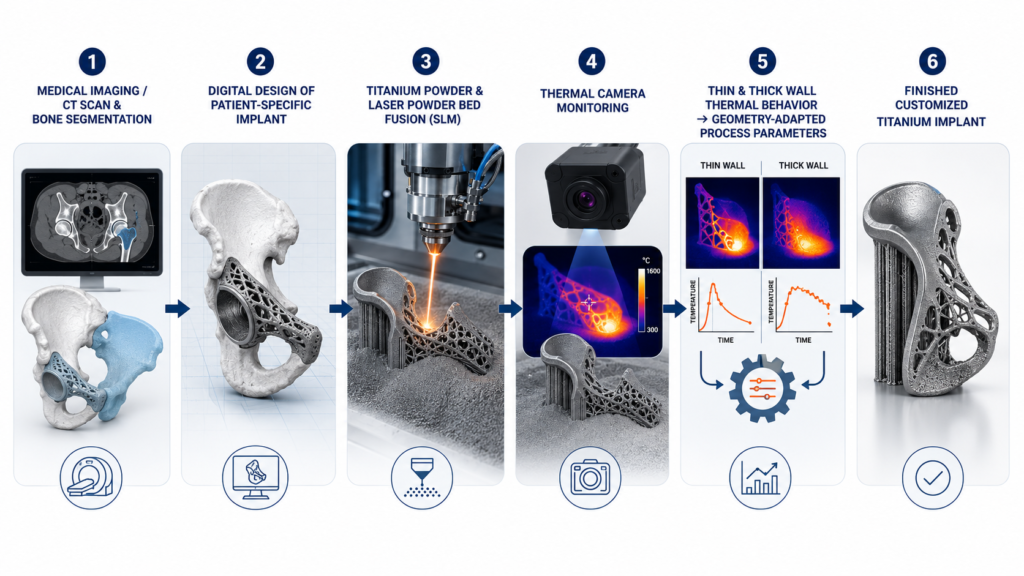
Within the ADAPT project, the printing process plays a central role in transforming advanced implant designs into real metallic components. The project focuses on the development of customized orthopaedic implants, especially for hip and knee applications, using digital design, advanced titanium alloys and laser-based metal additive manufacturing.
What is SLM / Laser Powder Bed Fusion?
One of the most relevant technologies for producing high-precision metallic implants is Selective Laser Melting, often referred to as SLM. In current terminology, the process is also commonly described as Laser Powder Bed Fusion, or PBF-LB.
In this process, a thin layer of metal powder is spread across a build platform. A focused laser beam selectively melts the powder according to the cross-section of the digital part. Once one layer is completed, the build platform moves down, a new layer of powder is applied, and the process is repeated. In this way, complex metal components can be built layer by layer.
The main advantage of PBF-LB is its ability to produce geometries that are difficult or impossible to manufacture using conventional methods. This includes lattice structures, porous surfaces for bone integration, lightweight internal features and patient-specific shapes derived from medical image data.
For orthopaedic implants, this is especially important. The implant is not only a mechanical component. It must interact with the human body, support load transfer, enable long-term stability and meet strict requirements regarding biocompatibility, surface quality and structural integrity.
Why Titanium Alloys?
Titanium and titanium-based alloys are widely used in medical applications due to their excellent combination of strength, corrosion resistance and biocompatibility. In orthopaedics, titanium alloys are particularly attractive because they can withstand high mechanical loads while remaining compatible with biological tissue.
In the ADAPT project, special attention is given to advanced titanium alloys for customized hip and knee implants. These materials are investigated not only from the perspective of mechanical performance, but also with regard to processability in laser-based additive manufacturing.
During PBF-LB, titanium powder is locally melted and rapidly solidified. This creates a complex thermal history inside the part. The final properties of the component depend strongly on the interaction between material, laser parameters, geometry and heat flow. Parameters such as laser power, scan speed, hatch distance, layer thickness and scan strategy influence density, microstructure, surface quality and residual stresses.
For medical implants, achieving a stable and reproducible process is essential. Defects such as porosity, lack of fusion, overheating or distortion can negatively affect the performance of the final component. Therefore, understanding and controlling the printing process is a key step toward reliable implant manufacturing.
Geometry Matters: Thin and Thick Walls Behave Differently
A major challenge in laser-based metal additive manufacturing is that not all areas of a part behave in the same way during printing. The geometry of the component strongly affects how heat is generated, distributed and dissipated.
Thin walls, thick walls, massive sections, fine structures and overhangs can all show different thermal behaviour, even when the same process parameters are used. A thin wall may cool down more quickly because there is less surrounding material to store heat. A thicker section, on the other hand, can accumulate more thermal energy, leading to higher local temperatures and different cooling rates.
This is highly relevant for customized implants. Orthopaedic components often combine compact load-bearing regions with thin features, porous structures or functional surfaces. Using only one fixed parameter set for the entire component may not always be optimal. Different geometrical regions may require adapted process conditions to achieve the same quality level throughout the part.
Investigating the Process with Thermal Imaging
To better understand these effects, the ADAPT project investigated the thermal behaviour of different wall thicknesses during the printing process. Using a thermal camera, temperature differences between thinner and thicker wall sections were observed during laser-based manufacturing.
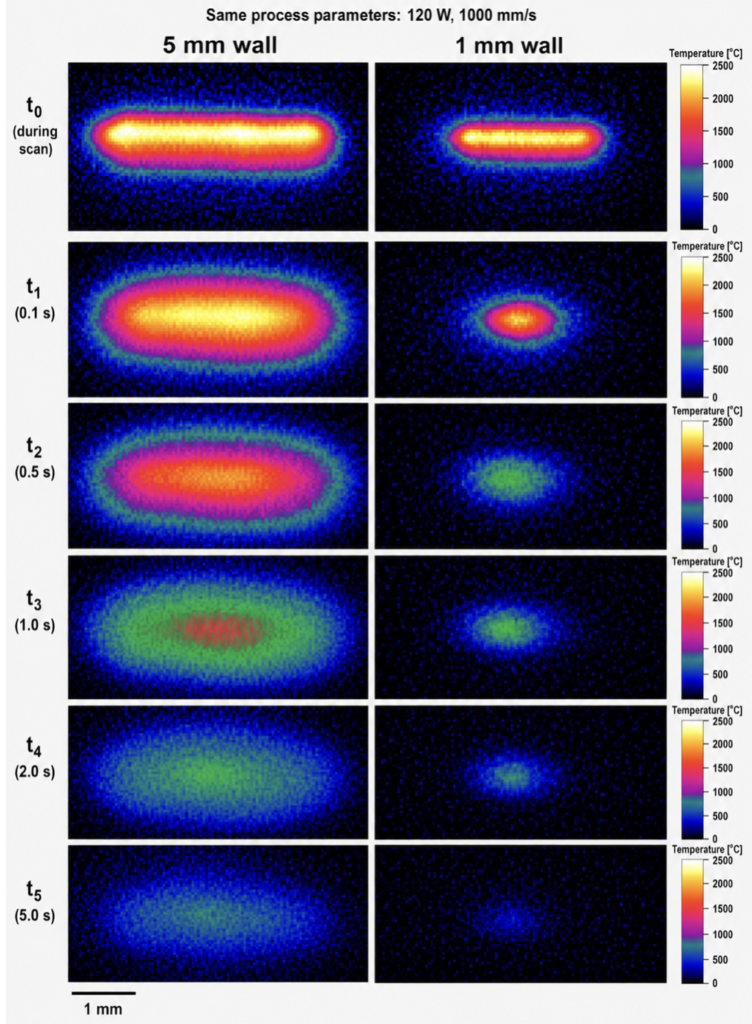
The goal of these investigations was to identify how geometry influences local heat accumulation and cooling behaviour. By comparing thin and thick wall structures under comparable process conditions, the project team gained valuable insights into the relationship between part geometry and temperature distribution.
Such thermal observations help to answer important process-related questions:
How does the temperature profile change between thin and thick sections?
Where does heat accumulate during printing?
How quickly do different geometries cool down?
Can critical areas be identified before defects occur?
How can process parameters be adapted to improve part quality?
These insights are an important step toward a more intelligent and geometry-aware manufacturing strategy.
Toward Geometry-Adapted Process Parameters
A future objective within ADAPT is to use this knowledge to support adapted process parameters depending on the geometry of the part. Instead of applying one general parameter set to the entire implant, different regions could be manufactured with optimized settings according to their thermal behaviour and functional requirements.
For example, thin structures may require different energy input than thick sections. Massive areas may need strategies to avoid overheating or excessive residual stresses. Porous regions may require carefully controlled parameters to achieve the intended architecture while maintaining mechanical stability.
This approach supports the broader ambition of the ADAPT project: moving toward a more reliable, efficient and “First-Time-Right” manufacturing process for customized metallic implants.
By combining digital design, material development, process monitoring and geometry-adapted manufacturing, ADAPT aims to improve the production of patient-specific orthopaedic implants. Thermal imaging is one of the tools helping the project team to better understand the process and make future printing strategies smarter, more stable and more sustainable.
Why This Matters for Customized Implants
Customized implants are inherently complex. Each patient-specific design may include unique geometries, different wall thicknesses and locally varying structural features. This makes process understanding even more important.
A robust printing strategy must ensure that every part of the implant meets the required quality standards, regardless of its local geometry. By investigating how different sections behave during manufacturing, ADAPT contributes to the development of more predictable and controlled production methods.
In the long term, geometry-adapted process parameters could help reduce trial-and-error development, improve repeatability, minimize material and energy waste, and support the industrial production of advanced patient-specific implants.
The printing process is therefore not only a manufacturing step. It is a central element in the digital value chain of ADAPT, connecting material science, implant design, process control and medical application.
„The project not only advances the development of patient-specific orthopaedic implants, but also highlights how regional know-how from Styria can contribute to future-oriented healthcare solutions with international relevance.“
Dr. Christian Pfeifer
For DISTech, the ADAPT project represents an important opportunity to strengthen the role of Styria as a region for advanced manufacturing, medical technology and applied innovation. By contributing industrial expertise in metal additive manufacturing, process development and implant demonstrator production, DISTech supports the transfer of cutting-edge research into practical medical applications. The project not only advances the development of patient-specific orthopaedic implants, but also highlights how regional know-how from Styria can contribute to future-oriented healthcare solutions with international relevance.“
Keywords: PBF-LB, SLM, additive manufacturing, titanium alloys, orthopaedic implants, thermal imaging, process monitoring, customized implants, laser powder bed fusion, geometry-adapted parameters