
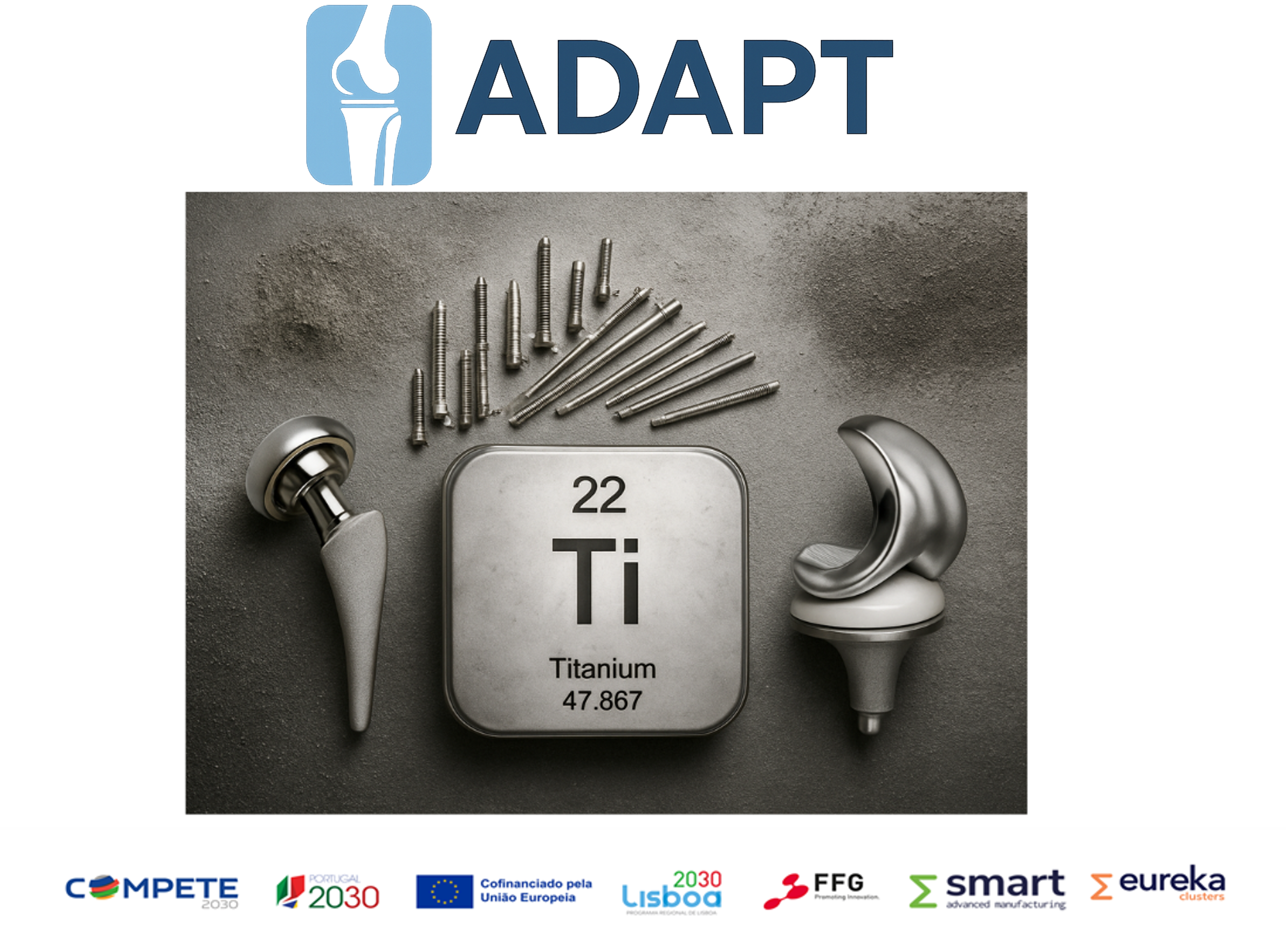
Envision a new era in medicine – one where implants are not only safer and more effective, but also engineered to the specific needs of every individual. The ADAPT project is leading this transformation, harnessing the power of advanced β-titanium alloy powders and state-of-the-art additive manufacturing to craft custom implants that truly fit each patient. This ground-breaking approach ensures better outcomes, faster recoveries, and a higher quality of life. Discover how titanium alloy powder atomization is driving this revolution.
Titanium has earned a reputation as one of the most reliable engineering metals in the world. It is a metal that is light yet very strong. Manufacturers use it in aircraft structures, deep-sea equipment, high-performance sports gear, jewelry, and more (see fig. 1). These environments demand strength, corrosion resistance, and durability, which titanium alloy provides.
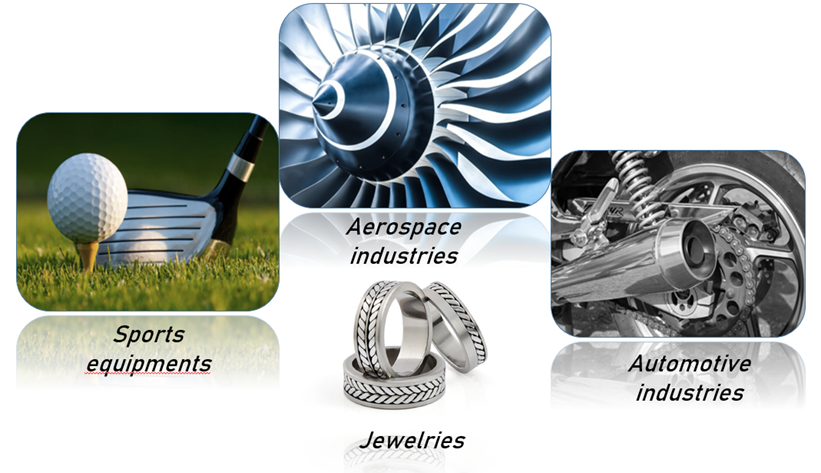
Titanium alloy and its applications
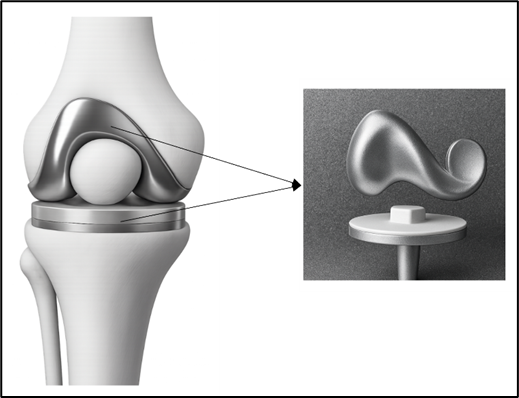
Beyond these industrial applications, titanium has also found one of its most meaningful roles: it is used inside the human body. In modern medicine, doctors widely use it for dental screws, bone plates, hip stems, and knee implants in arthroplasty surgeries for patients with degenerative conditions such as osteoarthritis. Figure 2 shows one such condition in the knee, with the replacement shown in a titanium alloy
Want to know more? Read more about titanium and its properties and uses on: https://www.britannica.com/science/titanium
Want to know more? Read more about titanium for medical uses: https://pmc.ncbi.nlm.nih.gov/articles/PMC10780041/
1 Biocompatibility of Titanium alloys
One of the key reasons manufacturers widely choose titanium for orthopedic implants is its exceptional biocompatibility. Biocompatibility, in this context, refers to a material’s ability to exist within the human body without provoking adverse reactions. Unlike many other metals, titanium naturally forms a thin, stable oxide layer (TiO₂) on its surface when exposed to oxygen. This oxide film acts as a protective barrier, preventing corrosion and reducing the release of metal ions into surrounding tissues. For instance, steel or iron without alloying would disintegrate and rust easily inside the human body, potentially causing severe effects. In simple terms, titanium interacts positively with our tissues [1].
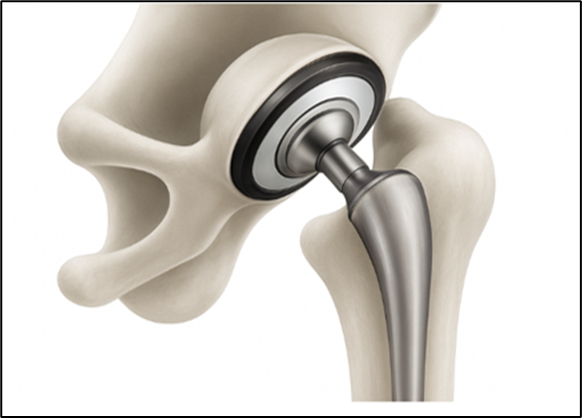
Bone cells readily attach to titanium, enabling osteointegration—the process by which natural bone grows directly onto the implant surface [2]. This biological bonding enhances the stability of the implant and reduces the risk of loosening over time, which is especially crucial for osteoarthritis patients who depend on long-term joint function. Furthermore, the elastic modulus of titanium alloys, such as Ti64, more closely matches that of natural bone than that of heavier metals like stainless steel or cobalt-chromium alloys. Collectively, the properties of corrosion resistance, biological acceptance, and mechanical compatibility make titanium one of the safest and most effective materials for load-bearing implants [3]. ]. In Figure 3, a schematic representation of the titanium implant in a human pelvis is shown
1.1 Biocompatible titanium alloys
The selection of metals for biomedical applications critically influences patient safety, long-term performance, and treatment success. While precious metals such as gold, silver, and platinum have historically played a significant role, modern medicine predominantly relies on advanced materials like austenitic stainless steels, cobalt-based alloys, and increasingly, titanium-based alloys for implants and prosthetics [4].
Notably, titanium-molybdenum (Ti-Mo) alloys, as Baltatu et al. [4] highlight, offer exceptional mechanical properties; for instance, they demonstrate higher tensile strength, superior corrosion resistance, and a modulus of elasticity that closely matches human bone. This matching, in turn, reduces the risk of stress shielding and thereby improves patient outcomes. Examples include Ti-12Mo-6Zr-2Fe, Ti-15Mo-5Zr-3Al, Ti-15Mo, Ti-10Mo-3Nb, and Ti-10Mo-1.7Si [4]. Moreover, Miinomi [5] documents a range of biocompatible titanium alloys, especially beta-titanium alloys with low elastic modulus and non-allergenic elements. These features, consequently, minimize adverse reactions and enhance patient comfort. Noteworthy compositions include Ti-13Nb-13Zr, Ti-16Nb-10Hf, Ti-30Ta, Ti-45Nb, and Ti-35Nb-7Zr-5Ta [5].
From an economic perspective, alloying titanium with manganese (Mn), tin (Sn), iron (Fe), and silicon (Si) yields high strength alongside a Young’s modulus similar to bone, all at a more affordable cost [6]. Examples such as Ti-10Sn, Ti-9Mn, and Ti-4Al-4Mo-2Sn-0.5Si [7] demonstrate how clinical performance can be balanced with economic feasibility. Consequently, these solutions make advanced biomaterials more accessible and transformative in modern medicine.
To realize these benefits in modern implant design, advanced manufacturing methods are necessary. Producing titanium implants with complex shapes and porous structures required for current joint replacements involves transforming the metal into a fundamentally different form: a finely engineered powder [8]
2 Titanium alloy Powders Atomization
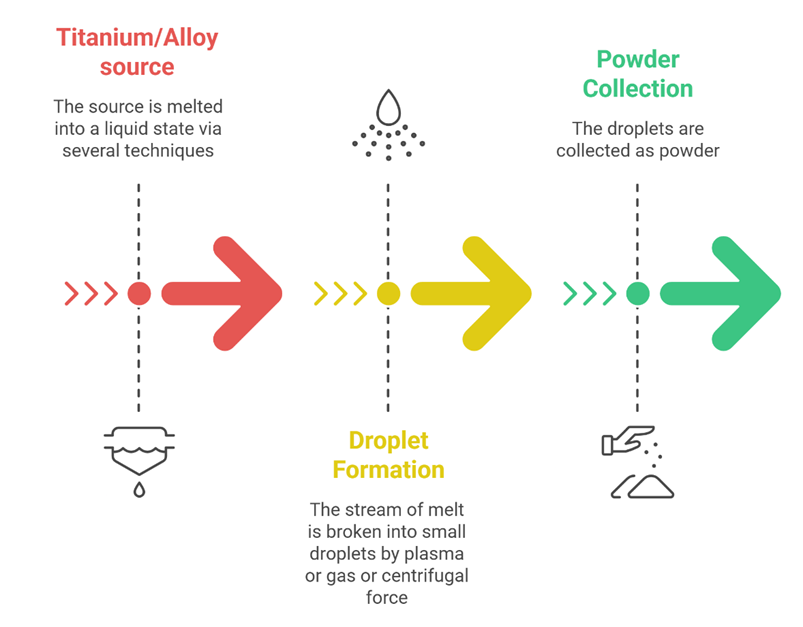
Before a titanium implant can restore mobility to an osteoarthritic joint or become part of the jawline, the metal must first undergo a remarkable transformation. It does not directly start as a knee replacement or a hip stem; instead, it begins as powder. Thousands of microscopic titanium particles, each engineered with precision, form the foundation of modern biomedical manufacturing. This transformation from solid metal to fine powder occurs through a process known as atomization.
Atomization involves breaking molten titanium into tiny droplets that rapidly solidify into spherical particles. A simple flowchart of the atomization process is shown in Figure 4. Although the concept sounds simple, the science behind it is quite complex. Titanium melts at extremely high temperatures—around 1668 °C—and reacts readily with oxygen, nitrogen, and other atmospheric elements. Any contamination at this stage can compromise corrosion resistance, mechanical strength, and, ultimately, biocompatibility. All of these factors are critical for implants that must function safely inside the human body for decades.
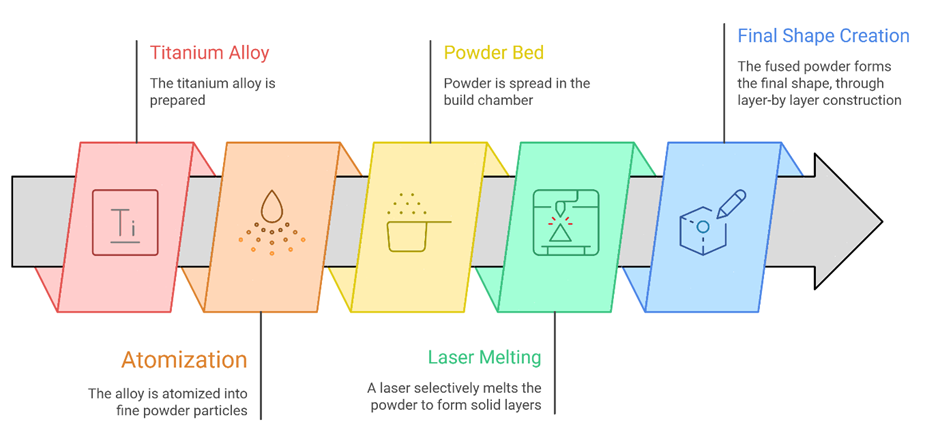
In biomedical applications, powder quality is not just a manufacturing concern; it is directly linked to patient outcomes. Specifically, the size, shape, purity, and internal structure of titanium powder determine how effectively an implant can be 3D printed, how porous it can be made, and how well bone tissue can grow into it. Therefore, for osteoarthritis patients receiving joint replacements, this microscopic powder engineering plays a crucial role in restoring pain-free movement.
3 Titanium alloys atomization techniques
Several advanced atomization methods are employed to produce biomedical-grade titanium powders. Each method utilizes extreme thermal and physical forces to transform molten metal into microscopic spheres within an interstellar-like atmosphere. Consequently, a generalized process of atomization is illustrated in the following figure.
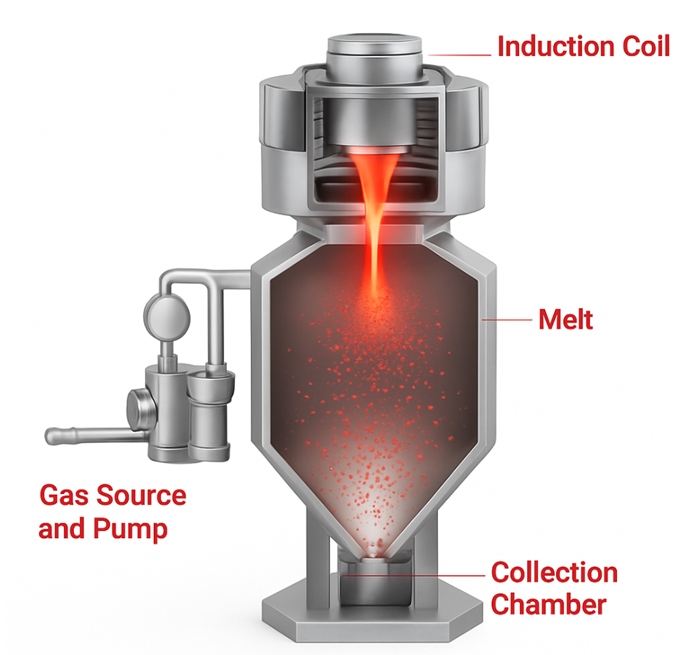
3.1 EIGA (electron induction gas atomization)
Electron-Induction Gas Atomization (EIGA) is widely regarded as one of the cleanest methods for producing titanium powder. In this process, a titanium bar is melted using electromagnetic induction inside a controlled environment. Once molten, the metal flows through a nozzle where it is struck by high-velocity inert gas jets (typically argon or helium). These gas streams then shatter the liquid metal into fine droplets, which rapidly cool and solidify into powder.
3.2 Plasma Atomization
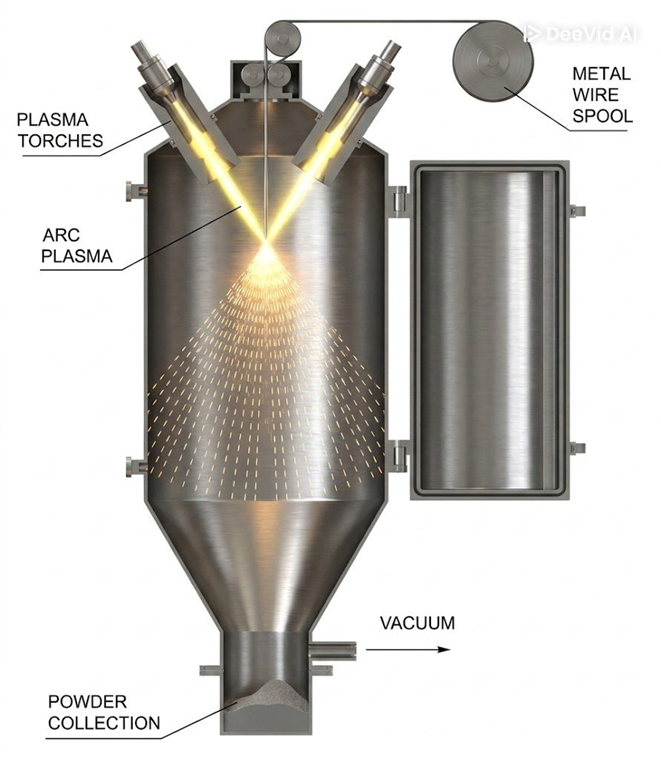
Plasma atomization represents an advanced stage in titanium powder production. Instead of melting a bulk bar, this process uses titanium wire as the feedstock. Specifically, the wire is fed into high-temperature plasma torches, where it is instantly melted and disintegrated by the plasma energy and gas flow.
Consequently, the result is exceptionally spherical powder particles with extremely smooth surfaces and minimal satellite formation, which are tiny particles stuck to larger ones. These characteristics, in turn, make plasma-atomized powders highly desirable for medical 3D printing, as flowability and packing density significantly influence implant quality
Additionally, this process occurs in an inert atmosphere, thereby preventing contamination sources.
3.3 PREP (Plasma Rotating Electrode Process)
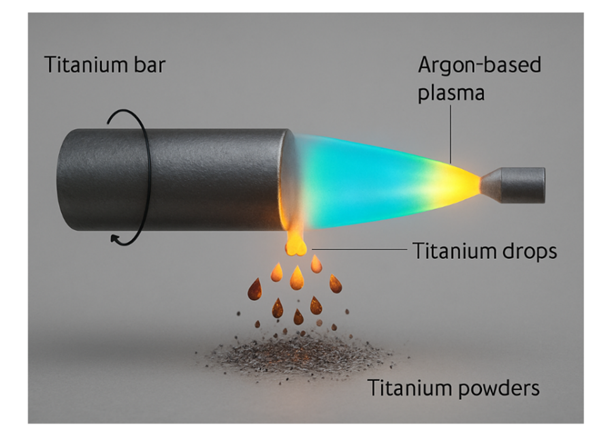
The Plasma Rotating Electrode Process (PREP) adopts a different physical approach. Specifically, a titanium rod serves as a rotating electrode. When a plasma arc melts the tip of this spinning rod, centrifugal forces cause molten droplets to eject outward. These droplets then solidify mid-flight into spherical powder particles.
Because the feedstock itself forms the electrode, PREP powders tend to exhibit high purity and low contamination. Furthermore, particle sizes are generally coarser than those produced by plasma atomization; however, they remain highly spherical. Consequently, this makes the process suitable for applications in both aerospace and biomedical fields.
3.4 Comparison of Atomization Processes
| Process | Feedstock Form | Purity Level | Particle Shape |
| EIGA | Bar/Rod | Very high | Spherical |
| Plasma Atomization | Wire | Ultra-high | Spherical |
| PREP | Bar/Rod | Very high | Spherical |
4 Additive Manufacturing – Metal 3D Printing
Once manufacturers atomize titanium into high-quality powder, they utilize it as the raw material for one of the most transformative manufacturing technologies in modern medicine: additive manufacturing, commonly known as 3D printing.
In this process, they spread thin layers of titanium powder across a build platform and selectively fuse them using a high-energy laser or electron beam. As the powder particles melt and solidify layer by layer, they gradually form a fully dense three-dimensional structure. Because engineers build the implant additively rather than machining it from a solid block, they can design highly complex geometries that were previously impossible to manufacture.
This capability, therefore, revolutionizes osteoarthritis treatment by enabling the production of joint implants with controlled porous architectures that mimic the trabecular structure of natural bone. These porous networks, in turn, allow bone tissue to grow into the implant, thereby enhancing fixation and long-term stability. Additionally, medical professionals can manufacture patient-specific implants using medical imaging data, ensuring a better anatomical fit and improved load distribution.
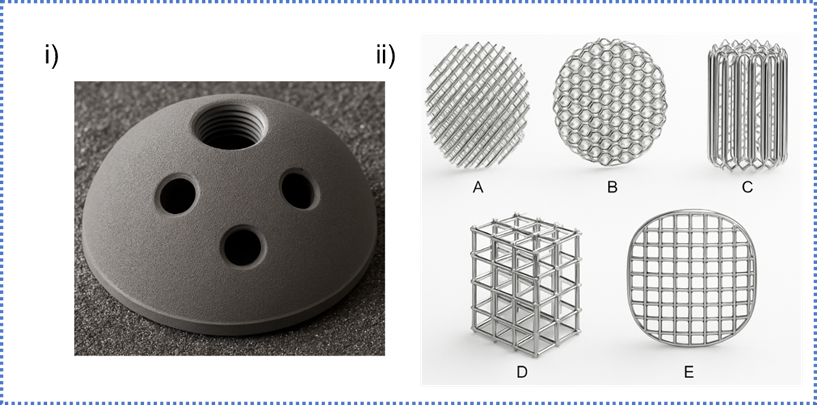
Another major advantage is material efficiency. Traditional machining wastes significant amounts of titanium; however, powder-based manufacturing uses only the precise amount needed to build the implant. This approach not only reduces costs but also promotes more sustainable production practices.
Ultimately, by combining high-purity atomized titanium powder with precision 3D printing, manufacturers can create implants that are lighter, stronger, and more biologically compatible. As a result, osteoarthritis patients benefit from improved mobility and longer implant lifespans.
5 From Powder to Patient
Atomization is a crucial step in preparing patients for joint replacements. Once atomized, titanium powder becomes the feedstock for advanced manufacturing technologies like Laser Powder Bed Fusion. As a result, layer by layer, these microscopic spheres are fused into complex, porous implant structures designed to mimic natural bone.
For osteoarthritis patients, this means:
- Better implant fixation
- Reduced risk of loosening
- Enhanced bone integration
- Longer implant lifespan
All made possible by how well the powder was engineered from the very beginning.
Furthermore, although atomization may occur far from the operating room—within high-temperature reactors and plasma arcs—it has a profoundly human impact. Each spherical titanium particle serves as a mobility-building block, enabling implants that not only replace damaged joints but also actively integrate with the body to restore movement and improve quality of life.
6 References
[1] T. Hanawa, “Biocompatibility of titanium from the viewpoint of its surface,” Sci. Technol. Adv. Mater., vol. 23, no. 1, pp. 457–472, Dec. 2022, doi: 10.1080/14686996.2022.2106156.
[2] D. D. Bosshardt, V. Chappuis, and D. Buser, “Osseointegration of titanium, titanium alloy and zirconia dental implants: current knowledge and open questions,” Periodontol. 2000, vol. 73, no. 1, pp. 22–40, Feb. 2017, doi: 10.1111/prd.12179.
[3] M. Niinomi, “Recent metallic materials for biomedical applications,” Metall. Mater. Trans. A, vol. 33, no. 3, pp. 477–486, Mar. 2002, doi: 10.1007/s11661-002-0109-2.
[4] M. S. Baltatu et al., “Biocompatible Titanium Alloys used in Medical Applications,” Rev. Chim., vol. 70, no. 4, pp. 1302–1306, May 2019, doi: 10.37358/RC.19.4.7114.
[5] M. Niinomi, “Biologically and Mechanically Biocompatible Titanium Alloys,” Mater. Trans., vol. 49, no. 10, pp. 2170–2178, 2008, doi: 10.2320/matertrans.L-MRA2008828.
[6] M. Abdel-Hady Gepreel and M. Niinomi, “Biocompatibility of Ti-alloys for long-term implantation,” J. Mech. Behav. Biomed. Mater., vol. 20, pp. 407–415, Apr. 2013, doi: 10.1016/j.jmbbm.2012.11.014.
[7] E. Marin and A. Lanzutti, “Biomedical Applications of Titanium Alloys: A Comprehensive Review,” Materials, vol. 17, no. 1, p. 114, Dec. 2023, doi: 10.3390/ma17010114.
[8] J. Gummadi and S. Alanka, “A review on titanium and titanium alloys with other metals for biomedical applications prepared by powder metallurgy techniques,” Mater. Today Proc., p. S2214785323022885, May 2023, doi: 10.1016/j.matpr.2023.04.387.
