
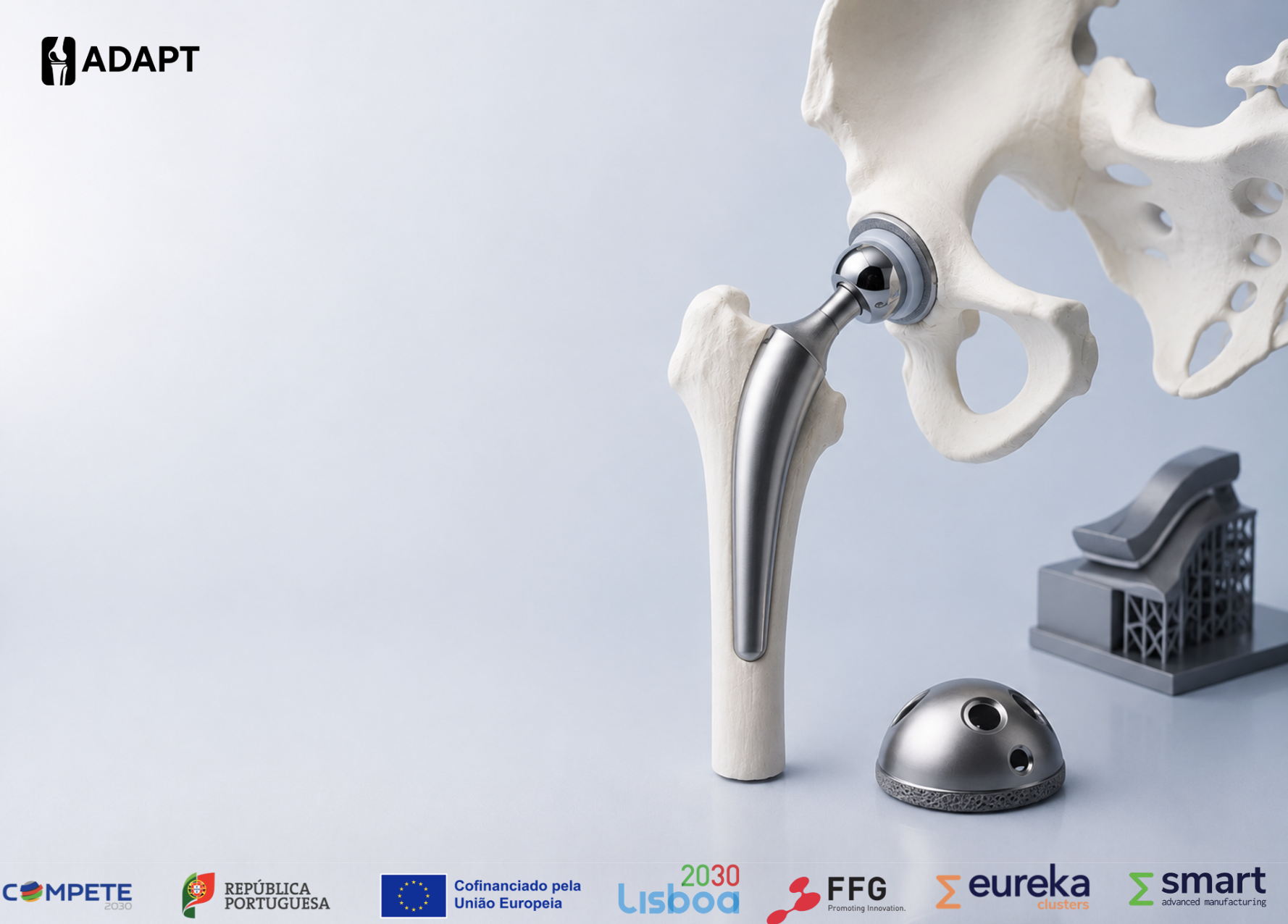
What if an orthopedic implant could be designed around a patient’s specific anatomy from the very beginning?
This question is at the heart of a broader transformation taking place in orthopedic manufacturing. Advances in medical imaging, artificial intelligence, generative design, and additive manufacturing are increasingly enabling the shift from standardized implant geometries to more personalized solutions.
Within the ADAPT (Digital Manufacturing of Customized Orthopaedic Implants) project, these technologies are being brought together to explore a more integrated approach to the design and manufacturing of customized metallic implants for the hip and knee. The project addresses the entire manufacturing chain, from anatomical data and intelligent implant design to additive manufacturing, post-processing and quality control.
From standardized implants to patient-specific design
Conventional orthopedic implants are typically available in a range of predefined sizes and geometries. This approach allows implants to be manufactured efficiently and made available to a broad patient population, but human anatomy does not always fit neatly into standardized categories.
Anatomical differences can make it challenging to achieve an optimal fit, particularly in patients with unusual morphology, complex bone defects, or significant anatomical variation.
Patient-specific implants offer a different approach: instead of selecting the closest available geometry, the implant can be designed around the individual patient’s anatomy.
ADAPT is exploring this approach specifically for customized hip and knee implants, to develop scalable digital and manufacturing solutions capable of producing complex, high-precision geometries tailored to individual patients.
What is generative design?
Generative design is a computational approach to product development in which algorithms generate and evaluate design solutions based on a set of predefined requirements and constraints.
Instead of starting with a fixed geometry and manually adapting it, the process starts with parameters. These may include:
- Patient-specific anatomical geometry
- Implant dimensions and positioning
- Mechanical requirements
- Material properties
- Manufacturing constraints
- Structural or functional requirements
The system can then explore different possible geometries and identify solutions that satisfy the defined criteria. In other words, generative design changes the question from “How should we modify this design?” to “What design best satisfies these requirements?”
For orthopedic implants, this approach can be particularly relevant because the geometry must simultaneously accommodate the patient’s anatomy, the implant’s functional requirements, and the constraints of the manufacturing process.
Connecting medical imaging, AI and implant design
Generative design does not exist in isolation. It can be part of a broader digital workflow that begins with the patient’s anatomy.
Medical imaging, such as computed tomography (CT), can provide detailed information about the patient’s bone geometry. AI-based segmentation can then help identify and reconstruct the relevant anatomical structures, transforming medical images into usable 3D information.
Research has already demonstrated the feasibility of connecting these stages. Burge, Jeffers and Myant developed an automated pipeline that used machine learning methods—including classification, object detection and image segmentation—to extract anatomical information from CT data, generate 3D models of the femur and tibia, and ultimately produce customized knee implant designs through computer-aided design. [1]
This illustrates an important principle: the more effectively anatomical information can be transformed into structured digital data, the greater the potential for automating the subsequent design process.
This is also where the different technological areas explored by ADAPT begin to connect. The project is developing AI-based algorithms for tomography segmentation alongside high-precision 3D generative designs for customized orthopedic implants.
From anatomy to a digital implant
The potential workflow can therefore be viewed as a connected digital chain:
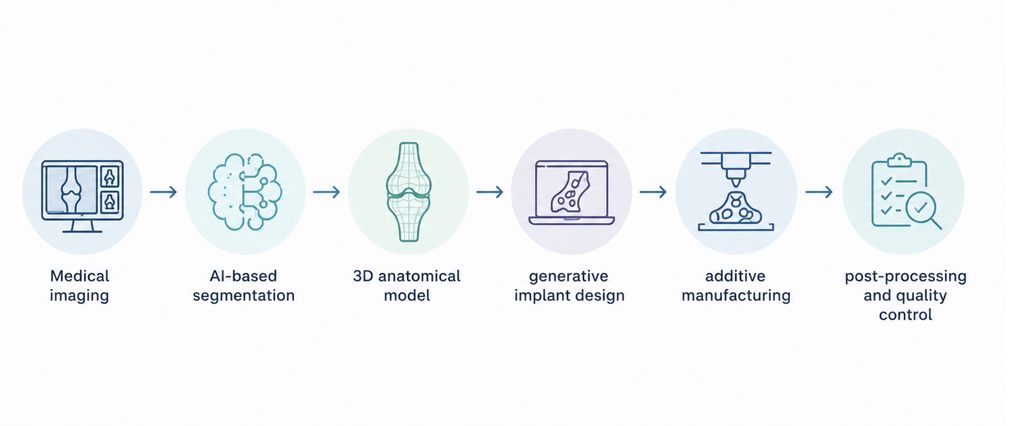
Each stage provides information that can influence the next.
The segmentation process transforms medical images into a representation of the patient’s anatomy. Generative design can then use that information to explore implant geometries adapted to the individual anatomy and defined engineering requirements.
Finally, additive manufacturing makes it possible to physically produce complex geometries that may be difficult or inefficient to manufacture using conventional techniques.
Recent research highlights additive manufacturing’s ability to produce orthopedic implants tailored to patient-specific anatomical data while offering greater design freedom and customization than many conventional manufacturing approaches. [2]
Why additive manufacturing matters
The benefits of generative design become particularly relevant when combined with additive manufacturing.
Traditional manufacturing processes can impose limitations on the geometries that can be economically produced. Additive manufacturing, by contrast, builds components layer by layer, enabling the production of complex structures directly from digital models.
For orthopedic applications, this can support the production of customized metallic implants and geometrically complex structures.
Among the available additive manufacturing technologies, Powder Bed Fusion – Laser Beam (PBF-LB) is particularly relevant for metal implants. The technology uses a laser to selectively fuse metal powder layer by layer, allowing complex geometries to be manufactured with a high degree of control.
Research into PBF of metal implants has highlighted both its potential for customized orthopedic applications and the need to address challenges related to materials, manufacturing parameters, quality assurance, and clinical translation. [3]
ADAPT is specifically investigating advanced PBF-LB technologies, including geometrically specialized laser toolpaths designed to improve control of heat distribution and residual stresses during manufacturing.
Designing for the patient and for manufacturing
A patient-specific design is only valuable if it can also be manufactured reliably.
This is one of the key challenges of personalized manufacturing.
A generative design may produce a geometry that is highly suitable from an anatomical or mechanical perspective, but the design must also take into account the characteristics of the material, the manufacturing process, post-processing requirements, and quality control.
This is why ADAPT approaches customization as a complete manufacturing chain rather than as an isolated design problem.
The project combines intelligent implant design with advanced additive manufacturing, materials development, post-processing, in-vitro testing and quality control. The aim is to ensure that the digital design can ultimately become a reliable physical implant.
From “trial and error” to “First-Time-Right”
One of the concepts at the centre of ADAPT is “First-Time-Right” manufacturing.
In complex additive manufacturing processes, achieving the desired result can require multiple iterations, adjustments and tests. Each unsuccessful iteration can consume additional material, energy and production time.
ADAPT aims to use digital technologies, including generative design and digital-twin approaches, to reduce this dependence on trial and error. By improving the ability to predict and optimize processes before and during manufacturing, the project aims to reduce defects and resource consumption across the value chain.
This is particularly important when customization is involved. If every implant is different, manufacturing processes need to become sufficiently flexible and predictable to handle variation without compromising quality or efficiency.
Personalization without losing scalability
One of the biggest challenges of customized healthcare products is finding the balance between individualization and industrial scalability.
Designing one unique implant manually for one patient is possible. Doing so efficiently for thousands of patients requires a fundamentally different approach. This is where automation becomes critical.
Research into automated customization of knee implants has shown that machine learning can be used to process CT data and generate customized implant designs with limited manual intervention, demonstrating the potential for more scalable approaches to personalization. [1]
ADAPT is pursuing a similar principle at a broader manufacturing level: connecting digital technologies with advanced manufacturing processes to create a more flexible and integrated pathway for customized metallic implants.
What could the future of orthopedic manufacturing look like?
The future of personalized orthopedic manufacturing may not be about creating increasingly complex implants simply for the sake of complexity. It is about creating a better connection between patient anatomy, engineering requirements, and manufacturing capabilities.
Imagine a workflow in which a patient’s anatomical data can be transformed into a digital model, an optimized implant geometry can be generated based on predefined requirements, and that design can then be transferred directly into an advanced manufacturing process.
This would create a much more continuous journey from patient data to physical implant. And the combination of AI, generative design, additive manufacturing and digital process control could make that journey increasingly automated, precise and scalable.
From the patient to the implant
This is the broader vision behind ADAPT.
By connecting technologies across the entire value chain—from anatomical scans and 3D digital models to generative implant design, PBF-LB manufacturing, post-processing and quality control—the project is exploring how customized orthopedic implants can become part of a more integrated and efficient manufacturing ecosystem.
The goal is not simply to make implants more complex. It is to make them more relevant to the individual patient, while making their production more predictable, efficient, and sustainable.
In the future, the question may no longer be: “Which implant fits this patient best?”
It could become: “How can we design and manufacture the implant that best fits this patient?”
And generative design may be one of the technologies that helps turn that question into reality.
References
[1] Burge, T. A., Jeffers, J. R. T., & Myant, C. W. (2023). Applying machine learning methods to enable automatic customisation of knee replacement implants from CT data. Scientific Reports, 13, 3317. [Read article]
[2] Wu, P., Liu, X., Guo, Z., & Lau, L. (2026). Personalization and Precision: Innovative Applications and Future Challenges of Additive Manufacturing in Orthopedic Implants. Journal of Orthopaedic Research, 44(2), e70082. [Read article]
[3] Lowther, M., Louth, S., Davey, A., Hussain, A., Ginestra, P., Carter, L., Eisenstein, N., Grover, L., & Cox, S. (2019). Clinical, industrial, and research perspectives on powder bed fusion additively manufactured metal implants. Additive Manufacturing, 28, 565–584. [Read article]
[4] ADAPT – Digital Manufacturing of Customized Orthopaedic Implants. SMART Eureka. [Project description]
[5] ADAPT – Digital Manufacturing of Customized Orthopaedic Implants. ISQ. [Project overview]