
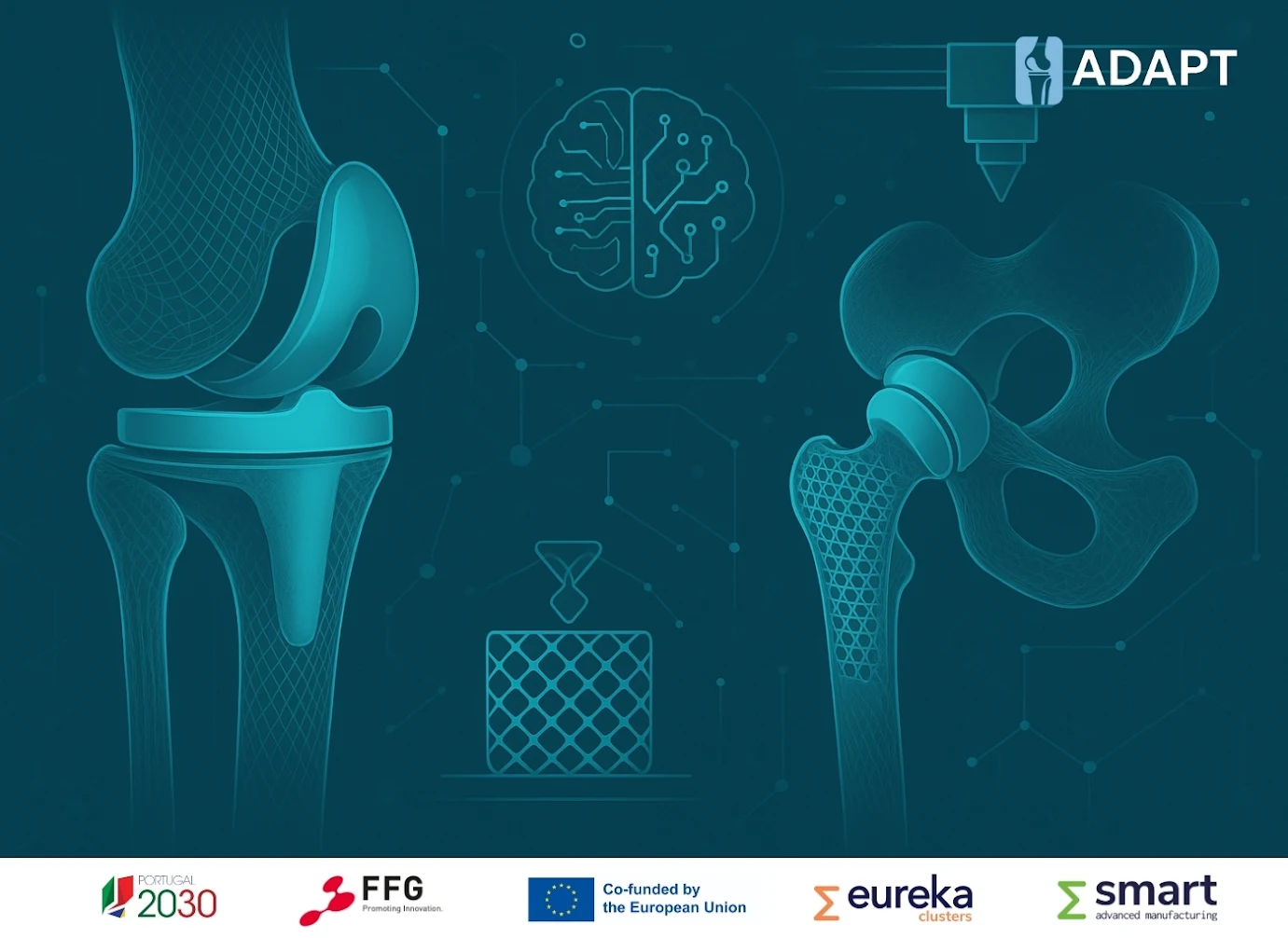
ADAPT Project: Advancing Personalized Orthopedic Implants Through Next-Generation Digital and Additive Manufacturing
Orthopedic medicine is undergoing a profound transformation. As the population ages and the demand for joint replacement surgeries continues to rise, traditional implant manufacturing methods face new challenges with increasing levels of complexity, customization needs, and quality expectations. Standardized implants, typically produced in a limited number of sizes, often fail to perfectly match the anatomy of individual patients, resulting in suboptimal fit, increased surgical challenges, and, in some cases, patient dissatisfaction.
The ADAPT project was created to address this challenge head-on. By integrating advanced materials research, next-generation digital workflows, and state-of-the-art additive manufacturing (AM), ADAPT aims to revolutionize how patient-specific orthopedic implants are designed, produced, and validated. Grounded in scientific excellence and powered by industry-leading innovation, the project brings together a consortium of Portuguese and Austrian partners committed to reshaping the future of personalized orthopedic care.
What Is ADAPT?
ADAPT is an international research and innovation project focused on developing an advanced solution for the industrial production of customized metallic orthopedic implants. The core vision of the project is to create an integrated ecosystem – from anatomical data processing to materials science, digital design, manufacturing, and quality assurance – that enables the reliable, efficient, and cost-effective fabrication of orthopedic implants tailored to the individual anatomy of each patient.
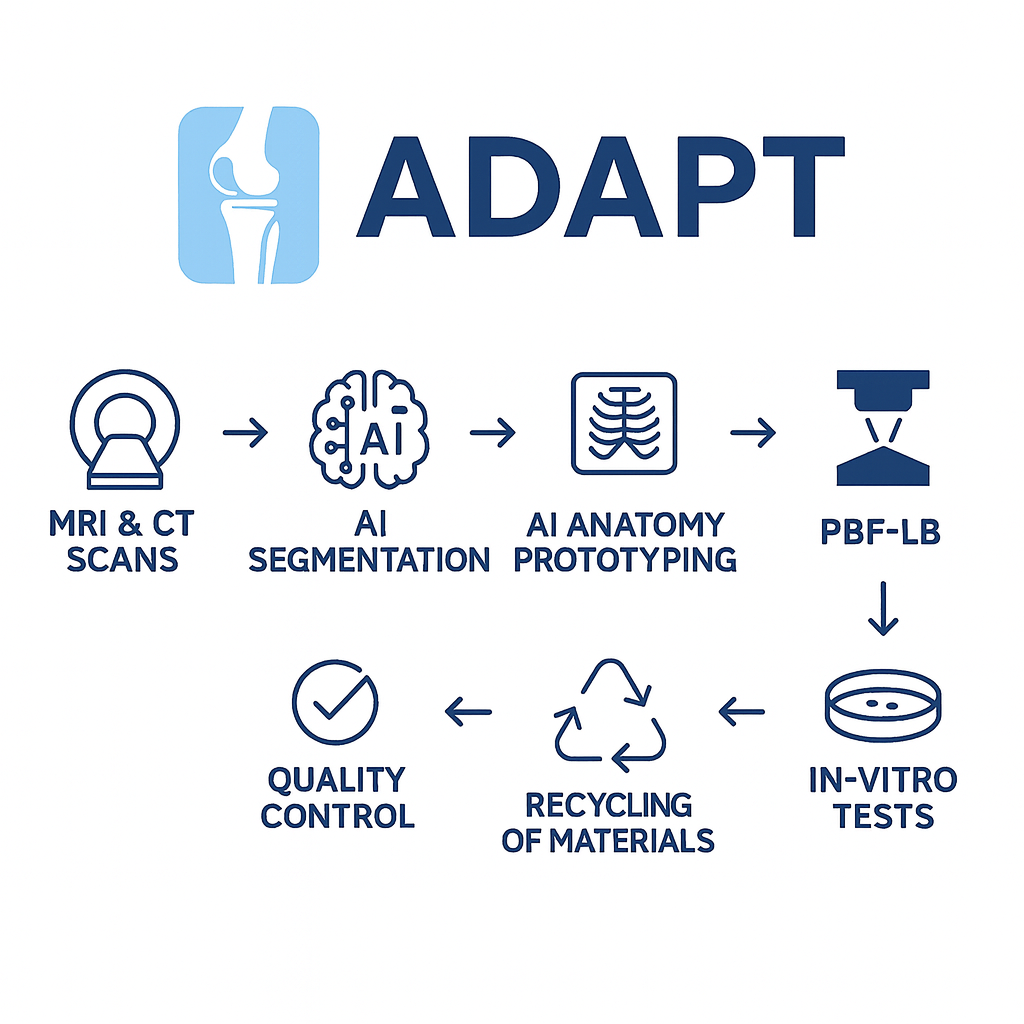
The project’s technological backbone lies in Additive Manufacturing (AM), specifically Powder Bed Fusion – Laser Beam (PBF-LB) technologies. These processes allow engineers to fabricate highly complex geometries and porous structures that cannot be achieved through traditional subtractive or casting methods. When combined with new digital advancements and novel medical-grade materials, AM becomes a powerful driver for fully personalized implant production.
ADAPT addresses the entire manufacturing chain, including:
- Upstream processes: anatomy scans, medical imaging, segmentation, 3D reconstruction, and CAD modeling.
- Core design & manufacturing processes: intelligent implant design, simulation, materials optimization, PBF-LB parameter development, process monitoring, and in-situ control.
- Downstream processes: post-processing, surface finishing, mechanical and microstructural testing, validation protocols, and quality assurance.
Through this comprehensive approach, ADAPT aims to deliver a new paradigm for producing high-performance, personalized orthopedic implants – efficiently, safely, and in a manner that dramatically reduces cost, metallic waste, and development time.
Why ADAPT?
Although traditional hip and knee joint implants are widely used and highly successful, current solutions are not always ideal for every patient. Traditional joint replacement relies on standardized implant sizes, requiring surgeons to choose the closest available fit. In many cases, none of the available sizes perfectly match the patient’s anatomy perfectly, leading to potential risks such as:
- over- or under-coverage of bone surfaces,
- suboptimal joint alignment,
- implant overhang and soft-tissue irritation,
- reduced mobility and comfort post-surgery,
- compromised long-term outcomes,
- higher revision surgery rates.
Patient-specific implants overcome these limitations by designing the implant to match the patient rather than forcing the patient to match the implant. The advantages include:
- optimal bone-implant contact,
- improved biomechanical performance,
- reduced surgical time and complexity,
- greater post-operative comfort,
- enhanced longevity of the implant,
- increased patient satisfaction.
Yet, despite these benefits, personalized orthopedic implants are not widely available. The reasons are tied to higher costs, manufacturing challenges, long production cycles, and the need for advanced materials and digital workflows that can adapt to individual anatomy.
ADAPT responds directly to these needs by developing technological, digital, and industrial innovations that turn personalized implants into a feasible, affordable and scalable solution for orthopedic care worldwide.
ADAPT Objectives
ADAPT innovates on multi-process AM of customized implants using achieving “First-Time-Right” manufacturing with the objectives:
- Develop an AI-based algorithm for segmentation of computed tomography (CT) and Magnetic Resonance Imaging (MRI) scans and high-precision 3D generative designs.
- Implement digital-twin systems for flexible manufacturing at different scales and materials conditions.
- Ultrasonic Atomization (UA) of medical grade Ti alloys qualified for orthopedic implants to ensure demanding, mechanical-functional and biocompatibility requirements.
- Implement advanced geometrically specialized laser toolpaths for precise control of heat distribution and residual stress on the implants produced by PBF-LB.
- Implant post-processing, in-vitro testing, quality control, and validation.
- Develop the process chain for recycling waste metallic materials back to UA.
ADAPT’s Technology and Innovation Pillars
ADAPT stands at the intersection of multiple fields. Its innovations fall into four main pillars:
Pillar 1: Advanced Medical Imaging and Digital Anatomy
Using CT and MRI scanning, segmentation, and AI-driven reconstruction, the project creates precise 3D models of patient anatomy. These models form the foundation for digital implant design and simulation.
Pillar 2: Smart Implant Design & Simulation
New algorithms, design rules, and biomechanical simulations allow engineers to generate implants tailored to each patient while ensuring optimal mechanical performance.
Pillar 3: Materials & Additive Manufacturing Innovation
The development of beta-Ti alloys and the optimization of PBF-LB parameters are among the project’s most technically ambitious goals. These innovations push the boundaries of what AM can achieve in metallic medical devices.
Pillar 4: Integrated Quality Control and Post-Processing
ADAPT focuses not only on manufacturing but also on ensuring that each and every implant meets the highest standards through structured inspection, non-destructive testing, microstructure validation, and mechanical characterization.
Through the combination of these pillars, ADAPT introduces a new blueprint for orthopedic implant manufacturing.
ADAPT’s Impact
The expected outcomes of ADAPT extend far beyond the lab or factory. Its impact will be felt across medicine, industry, and society.
Impact on Patients
- Implants that truly fit their anatomy
- Reduced post-surgical complications
- Faster recovery and rehabilitation
- Improved quality of life for aging populations
Impact on Surgeons and Hospitals
- Simplified surgical workflows and better pre-operative planning
- Reduced need for intraoperative adjustments
- Better long-term outcomes and fewer revision surgeries
- Access to advanced, tailor-made solutions
Impact on Industry
- A scalable, digital-driven manufacturing process
- Optimized use of materials and energy
- Reduced waste and improved sustainability
- Increased competitiveness for European medical device manufacturers
Impact on Research and Innovation
- New knowledge in materials science
- Breakthroughs in biomechanics and medical imaging
- Stronger bridges between engineering, medicine, and data science
ADAPT Partners
The ADAPT consortium brings together a multidisciplinary team of clinical, scientific, and industrial leaders.

A world-class reference in orthopedic sports medicine, a FIFA Medical Centre of Excellence (as also ESSKA, ISAKOS and ICRS centre), providing clinical expertise and validation for orthopedic applications.
Experts in advanced additive manufacturing, structural optimization, and Design for Additive Manufacturing (DfAM), supporting design and production workflows.

A leading research institution specializing in advanced materials and microstructure research, contributing essential knowledge on metals, porosity, and mechanical behavior.

A technology powerhouse in inspection, certification, engineering, and innovation, ensuring the reliability and industrial readiness of all downstream processes.

A MedTech pioneer developing the first fully automated AI-driven orthopedic surgery planning system.
Together, these partners form a cohesive ecosystem bridging medicine, engineering, and digital technologies to redefine personalized patient-specific orthopedic medicine.
A New Future for Customized Orthopedic Implants
ADAPT is setting the foundation for a future where orthopedic implants are engineered with precision, manufactured with efficiency, and personalized for every patient. By combining cutting-edge digital tools, innovative materials, and robust industrial processes, the project delivers a new, integrated vision for orthopedic care.
Its outcomes will support a more sustainable, data-driven, and patient-centered medical device industry: one capable of meeting the demands of a rapidly evolving healthcare landscape.
This project is supported by SMART EUREKA CLUSTER, the Austrian Österreichische Forschungsförderungsgesellschaft mbH (FGG), Portugal2030, and is co-founded by the European Union .